 BirdTrout
Open the map
BirdTrout
Open the map
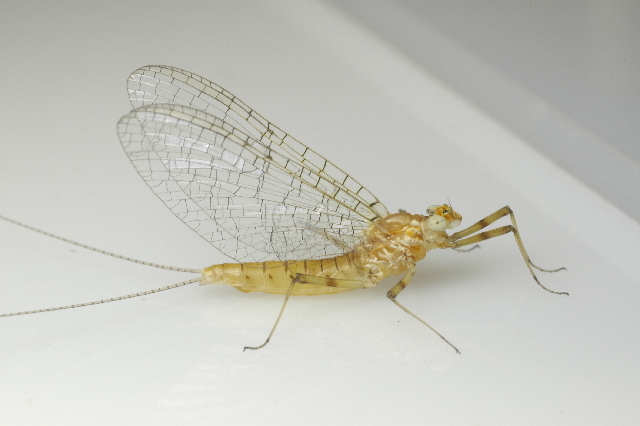
Cream Cahill (Maccaffertium modestum)
Mayfly, hatching July–August, active in water between 62 and 74°F, and imitated at #14–16. Recorded from southern lower Michigan, where 155 Michigan rivers on this site carry a page.

- #14–16Hook size
- 62–74°FWater, active
- Jul–AugPeak months
- 4Life stages fished
What it is
Mayfly · Maccaffertium modestum · nymph → emerger → dun → spinner
Very pale — near white-cream body and wings, two tails — and a size smaller than the Light Cahill it follows. Same flat clinger nymph.
Later and paler than the Light Cahill, and the reason a midsummer evening on warm freestone water still has duns on it after the good hatches are finished.
When it hatches
Peak is July–August. The pale months either side are the shoulder — the app widens a peak by one month in each direction and recommends the bug there, and no further: that widening is bounded so that a bug peaking in May is never offered in August.
peak shoulder not recommended
Water conditions
The band is a water temperature, not an air temperature, and it is the range in which this insect is worth fishing — for a mayfly that is the emergence window; for a scud or a midge it is simply the range trout will still eat one in.
Active from 62°F to 74°F. On this map that is cold-transitional, cool, warm water — the band crosses 2 of the three breaks the river colours use. Breaks at 58, 64 and 70°F.
Stages
What the insect is doing, and what that means for what you tie on.
| Stage | What it is |
|---|---|
| nymph | A clinger on rock in warmer water than most of its relatives will hold in, which is why it is the Cahill still available in late July. |
| emerger | In the film at last light, in ones and twos rather than in a wave. |
| dun | The pale dun still on the water in midsummer after the good hatches have finished. Rarely dense, reliably present. |
| spinner | A late-evening fall, spent-winged and very pale. |
Matching flies
4 patterns in this book imitate the Cream Cahill, across its stages. Which one to tie on follows the stage the water temperature says it is in — the app makes that call on a live reading; this page lists the whole set.
- Cahill Comparadun emerger · #14–18 — No hackle, deer-hair wing, body in the film. What to change to when the fish start refusing the standing dun.
- Hare's Ear Nymph nymph · #10–18 — Looks like everything and nothing. The other half of a two-nymph rig.
- Light Cahill dry fly · #12–16 — Cream body, ginger hackle. An evening fly from late May onward on freestone water.
- Rusty Spinner dry fly · #14–20 — Almost every mayfly spinner is rust-coloured. This covers the last hour of light.
Where to find it right now
The rivers with a page here that sit in this insect's regions, with a USGS gauge reporting water temperature. This list is re-ranked against the reading each gauge is sending now and today's date, so it is live — the fallback below it, if the readings do not arrive, is each river's measured July mean.
- Handy Creek southern lower Michigan · July mean 69.7°F
- Little Muskegon River southern lower Michigan · July mean 69.7°F
- Rice Creek southern lower Michigan · July mean 69.7°F
- Tamarack Creek southern lower Michigan · July mean 69.7°F
- Blue Lake Drain southern lower Michigan · July mean 66.0°F
- Fivemile Creek southern lower Michigan · July mean 66.0°F
- Flinton Creek southern lower Michigan · July mean 66.0°F
- James Creek southern lower Michigan · July mean 66.0°F
- Martin Creek southern lower Michigan · July mean 66.0°F
- Mena Creek southern lower Michigan · July mean 66.0°F
Regional presence
Regions, not collection records. This insect is recorded from the coarse regions below; nobody has surveyed which named river it has been caught on, and this page will not pretend otherwise.
- southern lower Michigan MI
- the Wisconsin driftless WI
- the Virginia mountains VA
- the North Carolina mountains NC
Rivers in these regions with a page here
- Kalamazoo River
- Apel Drain
- Augusta Creek
- Bancroft Noles Drain
- Bassett Creek
- Bear Creek
- Bear Creek
- Belle River
- Bennett Creek
- Big Creek
- Big Dailey Bayou
- Big and Outlet Drain
- Bigelow Creek
- Black River
- Black River Canal
- Blue Lake Drain
- Brandy Creek
- Brayton Drain
- Brooks Creek
- Bunton Drain
- Butler Creek
- Camp Brook Drain
- Cave Creek
- Cedar Creek
- and 131 more
Related hatches
Same family, or overlapping this one's calendar on the same water.
- Isonychia / Slate Drake Isonychia bicolor · Mayfly · June–September
- Trico Tricorythodes spp. · Mayfly · July–September
- Yellow Drake Ephemera varia · Mayfly · June–August
- Golden Drake Anthopotamus distinctus · Mayfly · July–August
- Little Yellow May Leucrocuta / Heptagenia spp. · Mayfly · June–September