 BirdTrout
Open the map
BirdTrout
Open the map
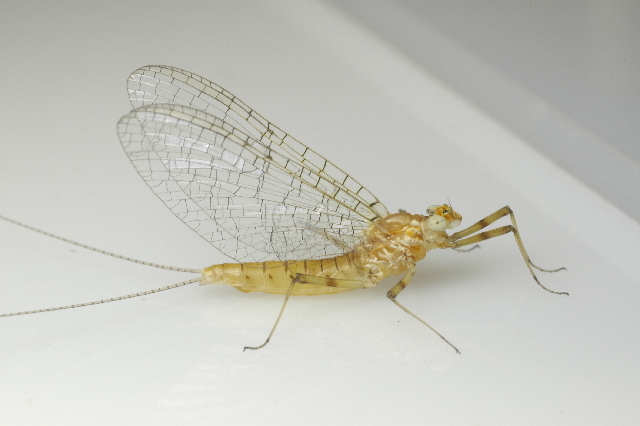
Light Cahill (Maccaffertium ithaca)
Mayfly, hatching May–July, active in water between 55 and 68°F, and imitated at #12–16. Recorded from the North Carolina mountains, where 1575 North Carolina rivers on this site carry a page.

- #12–16Hook size
- 55–68°FWater, active
- May–JulPeak months
- 4Life stages fished
What it is
Mayfly · Maccaffertium ithaca · nymph → emerger → dun → spinner
A cream-to-pale-yellow mayfly with faintly mottled cream wings and two tails. The nymph is a flat-bodied clinger, mottled brown, with sprawling legs.
A cream-yellow evening mayfly on freestone water, running from the tail of the Hendricksons into midsummer. The nymph is a flat-bodied clinger, so it is worth fishing tight to rock rather than in open current.
When it hatches
Peak is May–July. The pale months either side are the shoulder — the app widens a peak by one month in each direction and recommends the bug there, and no further: that widening is bounded so that a bug peaking in May is never offered in August.
peak shoulder not recommended
Water conditions
The band is a water temperature, not an air temperature, and it is the range in which this insect is worth fishing — for a mayfly that is the emergence window; for a scud or a midge it is simply the range trout will still eat one in.
Active from 55°F to 68°F. On this map that is cold, cold-transitional, cool water — the band crosses 2 of the three breaks the river colours use. Breaks at 58, 64 and 70°F.
Stages
What the insect is doing, and what that means for what you tie on.
| Stage | What it is |
|---|---|
| nymph | Clings to the sides and tops of rocks in moderate to fast current. Fish it tight to the rock rather than in the open channel. |
| emerger | Comes off through the surface in the evening, quickly in warm water. A film pattern matters less here than in the smaller hatches, but it still helps in flat runs. |
| dun | Pale and conspicuous at dusk, and the reason 'a Cahill' is what half the fly boxes in the East have in June. |
| spinner | An evening fall with the wings flat on the water; the body goes from cream to a deeper tan as the fly dies. |
Matching flies
4 patterns in this book imitate the Light Cahill, across its stages. Which one to tie on follows the stage the water temperature says it is in — the app makes that call on a live reading; this page lists the whole set.
- Cahill Comparadun emerger · #14–18 — No hackle, deer-hair wing, body in the film. What to change to when the fish start refusing the standing dun.
- Hare's Ear Nymph nymph · #10–18 — Looks like everything and nothing. The other half of a two-nymph rig.
- Light Cahill dry fly · #12–16 — Cream body, ginger hackle. An evening fly from late May onward on freestone water.
- Rusty Spinner dry fly · #14–20 — Almost every mayfly spinner is rust-coloured. This covers the last hour of light.
Where to find it right now
The rivers with a page here that sit in this insect's regions, with a USGS gauge reporting water temperature. This list is re-ranked against the reading each gauge is sending now and today's date, so it is live — the fallback below it, if the readings do not arrive, is each river's measured July mean.
- Back Creek the North Carolina mountains · July mean 59.3°F
- Beaverdam Creek the North Carolina mountains · July mean 59.3°F
- Bill Davenport Branch the North Carolina mountains · July mean 59.3°F
- Bill White Creek the North Carolina mountains · July mean 59.3°F
- Black Fork the North Carolina mountains · July mean 59.3°F
- Bridge Branch the North Carolina mountains · July mean 59.3°F
- Brier Creek the North Carolina mountains · July mean 59.3°F
- Buckwheat Branch the North Carolina mountains · July mean 59.3°F
- Bull Branch the North Carolina mountains · July mean 59.3°F
- Cambric Branch the North Carolina mountains · July mean 59.3°F
Regional presence
Regions, not collection records. This insect is recorded from the coarse regions below; nobody has surveyed which named river it has been caught on, and this page will not pretend otherwise.
- northern lower Michigan MI
- southern lower Michigan MI
- the Upper Peninsula MI
- the Wisconsin driftless WI
- northern Wisconsin WI
- the Virginia mountains VA
- the North Carolina mountains NC
- southeast Minnesota MN
Rivers in these regions with a page here
- Catawba River
- Aaron Creek
- Acorn Branch
- Adamcamp Branch
- Aiken Mill Creek
- Alarka Creek
- Alfred Creek
- Allison Creek
- Allmon Creek
- Ammons Branch
- Amos Creek
- Amos Creek
- Anderson Creek
- Anderson Creek
- Anderson Creek
- Anderson Creek
- Andrews Creek
- Anthony Bolick Branch
- Anthony Creek
- Appletree Branch
- Ararat River
- Armstrong Creek
- Arrowhead Branch
- Arrowwood Creek
- and 1551 more
Related hatches
Same family, or overlapping this one's calendar on the same water.
- Sulphur Ephemerella invaria · Mayfly · May–July
- Little Sulphur Ephemerella dorothea · Mayfly · May–July
- Isonychia / Slate Drake Isonychia bicolor · Mayfly · June–September
- Little Yellow May Leucrocuta / Heptagenia spp. · Mayfly · June–September
- March Brown Maccaffertium vicarium · Mayfly · May–June