 BirdTrout
Open the map
BirdTrout
Open the map
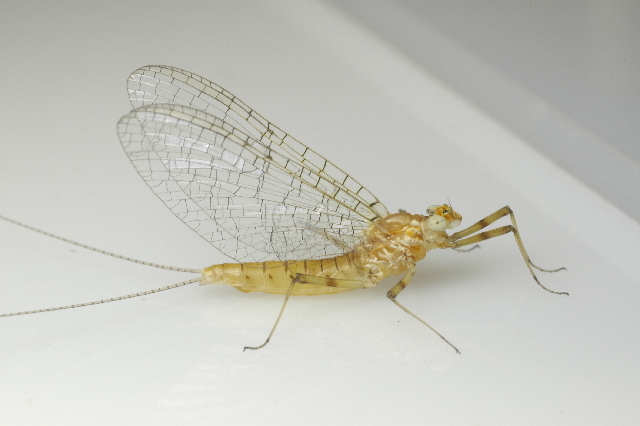
Light Cahill (Maccaffertium ithaca)
Mayfly, hatching May–July, active in water between 55 and 68°F, and imitated at #12–16. Recorded from every region this map covers, across Michigan, Wisconsin, Virginia, North Carolina and Minnesota.

- #12–16Hook size
- 55–68°FWater, active
- May–JulPeak months
- 4Life stages fished
What it is
Mayfly · Maccaffertium ithaca · nymph → emerger → dun → spinner
A cream-to-pale-yellow mayfly with faintly mottled cream wings and two tails. The nymph is a flat-bodied clinger, mottled brown, with sprawling legs.
A cream-yellow evening mayfly on freestone water, running from the tail of the Hendricksons into midsummer. The nymph is a flat-bodied clinger, so it is worth fishing tight to rock rather than in open current.
When it hatches
The months below are this site's shared calendar, which covers 8 regions at once. In southeast Minnesota the state's own source says June, and the Minnesota page is built on that instead.
Peak is May–July. The pale months either side are the shoulder — the app widens a peak by one month in each direction and recommends the bug there, and no further: that widening is bounded so that a bug peaking in May is never offered in August.
peak shoulder not recommended
Water conditions
The band is a water temperature, not an air temperature, and it is the range in which this insect is worth fishing — for a mayfly that is the emergence window; for a scud or a midge it is simply the range trout will still eat one in.
Active from 55°F to 68°F. On this map that is cold, cold-transitional, cool water — the band crosses 2 of the three breaks the river colours use. Breaks at 58, 64 and 70°F.
Stages
What the insect is doing, and what that means for what you tie on.
| Stage | What it is |
|---|---|
| nymph | Clings to the sides and tops of rocks in moderate to fast current. Fish it tight to the rock rather than in the open channel. |
| emerger | Comes off through the surface in the evening, quickly in warm water. A film pattern matters less here than in the smaller hatches, but it still helps in flat runs. |
| dun | Pale and conspicuous at dusk, and the reason 'a Cahill' is what half the fly boxes in the East have in June. |
| spinner | An evening fall with the wings flat on the water; the body goes from cream to a deeper tan as the fly dies. |
Matching flies
4 patterns in this book imitate the Light Cahill, across its stages. Which one to tie on follows the stage the water temperature says it is in — the app makes that call on a live reading; this page lists the whole set.
- Cahill Comparadun emerger · #14–18 — No hackle, deer-hair wing, body in the film. What to change to when the fish start refusing the standing dun.
- Hare's Ear Nymph nymph · #10–18 — Looks like everything and nothing. The other half of a two-nymph rig.
- Light Cahill dry fly · #12–16 — Cream body, ginger hackle. An evening fly from late May onward on freestone water.
- Rusty Spinner dry fly · #14–20 — Almost every mayfly spinner is rust-coloured. This covers the last hour of light.
Where to find it right now
The rivers with a page here that sit in this insect's regions, with a USGS gauge reporting water temperature. This list is re-ranked against the reading each gauge is sending now and today's date, so it is live — the fallback below it, if the readings do not arrive, is each river's measured July mean.
- Black Earth Creek the Wisconsin driftless · July mean 61.6°F
- Baldwin River northern lower Michigan · July mean 61.3°F
- Beaver Creek northern lower Michigan · July mean 61.3°F
- Bray Creek northern lower Michigan · July mean 61.3°F
- Coe Creek northern lower Michigan · July mean 61.3°F
- Diamond Lake Outlet Creek northern lower Michigan · July mean 61.3°F
- East Branch Hersey Creek northern lower Michigan · July mean 61.3°F
- East Branch Pine River northern lower Michigan · July mean 61.3°F
- Hersey Creek northern lower Michigan · July mean 61.3°F
- Hoxey Creek northern lower Michigan · July mean 61.3°F
Regional presence
Regions, not collection records. This insect is recorded from the coarse regions below; nobody has surveyed which named river it has been caught on, and this page will not pretend otherwise.
- northern lower Michigan MI
- southern lower Michigan MI
- the Upper Peninsula MI
- the Wisconsin driftless WI
- northern Wisconsin WI
- the Virginia mountains VA
- the North Carolina mountains NC
- southeast Minnesota MN
Rivers in these regions with a page here
- Au Sable River
- Catawba River
- Jackson River
- Muskegon River
- Escanaba River
- Saint Croix River
- Smith River
- Tygart Valley River
- Kalamazoo River
- Aaron Creek
- Aaron Run
- Aarons Run
- Abb Run
- Abes Run
- Abitosse Creek
- Abram Creek
- Acme Creek
- Acorn Branch
- Adamcamp Branch
- Adams Creek
- Adams Creek
- Adamson Run
- Addis Creek
- Adkins Rockhouse Branch
- and 6470 more
Related hatches
Same family, or overlapping this one's calendar on the same water.
- Sulphur Ephemerella invaria · Mayfly · May–July
- Little Sulphur Ephemerella dorothea · Mayfly · May–July
- Isonychia / Slate Drake Isonychia bicolor · Mayfly · June–September
- Little Yellow May Leucrocuta / Heptagenia spp. · Mayfly · June–September
- March Brown Maccaffertium vicarium · Mayfly · May–June