 BirdTrout
Open the map
BirdTrout
Open the map
Crayfish (Orconectes spp.)
Crustacean, hatching May–October, active in water between 55 and 78°F, and imitated at #4–8. Recorded from northern lower Michigan, southern lower Michigan and the Upper Peninsula, where 1140 Michigan rivers on this site carry a page.
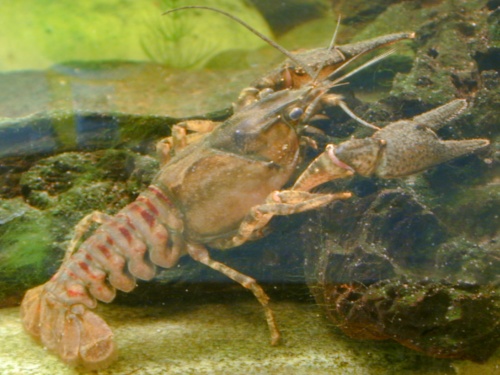

Not an insect at all but a freshwater crustacean, olive to rust to almost blue, running backwards in short bursts along the bottom. Where they are abundant they are the largest single item in a big brown trout's diet, and the largest single meal in most trout streams. Imitations are tied on size 4 to 8 hooks. The active band runs 55 to 78 degrees, wide enough to cover cold, cold-transitional, cool and warm water, and the peak stretches from May through October. Presentation is the whole discipline: fished on the bottom, moved in short strips or hops, and allowed to fall between them. A crayfish that swims steadily upstream is imitating nothing that has ever lived. A Clouser Crayfish in 4 to 8 is the literal match; a brown Woolly Bugger in 2 to 12, a Zonker in 2 to 8, or a Circus Peanut in 2 to 6 all cover the same profile.
- #4–8Hook size
- 55–78°FWater, active
- May–OctPeak months
- 1Life stage fished
What it is
Crustacean · Orconectes spp. · adult
Not an insect. A freshwater crustacean, olive to rust to almost blue, running backwards in short bursts along the bottom. Where they are abundant they are the largest single item in a big brown trout's diet.
The largest single meal in most trout streams. Fished on the bottom, moved in short hops, not stripped.
When it hatches
Peak is May–October. The pale months either side are the shoulder — the app widens a peak by one month in each direction and recommends the bug there, and no further: that widening is bounded so that a bug peaking in May is never offered in August.
peak shoulder not recommended
Water conditions
The band is a water temperature, not an air temperature, and it is the range in which this insect is worth fishing — for a mayfly that is the emergence window; for a scud or a midge it is simply the range trout will still eat one in.
Active from 55°F to 78°F. On this map that is cold, cold-transitional, cool, warm water — the band crosses 3 of the three breaks the river colours use. Breaks at 58, 64 and 70°F.
Stages
What the insect is doing, and what that means for what you tie on.
| Stage | What it is |
|---|---|
| adult | Fished on the bottom, moved in short strips, and allowed to fall. A crayfish that swims steadily upstream is imitating nothing that has ever lived. |
Matching flies
4 patterns in this book imitate the Crayfish, across its stages. Which one to tie on follows the stage the water temperature says it is in — the app makes that call on a live reading; this page lists the whole set.
- Circus Peanut streamer · #2–6 — Articulated, rubber-legged, unapologetic. A Michigan big-brown fly.
- Clouser Crayfish streamer · #4–8 — Moved in short hops along the bottom. A crayfish never swims across a river.
- Woolly Bugger (Brown) streamer · #2–12 — Brown with a bit of copper reads as a crayfish. Hop it along the bottom.
- Zonker streamer · #2–8 — Rabbit strip that breathes at rest. Deadly on the pause, not on the strip.
Where to find it right now
The rivers with a page here that sit in this insect's regions, with a USGS gauge reporting water temperature. This list is re-ranked against the reading each gauge is sending now and today's date, so it is live — the fallback below it, if the readings do not arrive, is each river's measured July mean.
- Bruce Creek the Upper Peninsula · July mean 66.8°F
- Camp Creek the Upper Peninsula · July mean 66.8°F
- Caps Creek the Upper Peninsula · July mean 66.8°F
- East Branch Fence River the Upper Peninsula · July mean 66.8°F
- Fence River the Upper Peninsula · July mean 66.8°F
- Fribley Creek the Upper Peninsula · July mean 66.8°F
- Hickman Creek the Upper Peninsula · July mean 66.8°F
- Jones Camp Creek the Upper Peninsula · July mean 66.8°F
- Klippel Creek the Upper Peninsula · July mean 66.8°F
- Koops Creek the Upper Peninsula · July mean 66.8°F
Regional presence
Regions, not collection records. This insect is recorded from the coarse regions below; nobody has surveyed which named river it has been caught on, and this page will not pretend otherwise.
- northern lower Michigan MI
- southern lower Michigan MI
- the Upper Peninsula MI
- the Wisconsin driftless WI
- northern Wisconsin WI
- the Virginia mountains VA
- the North Carolina mountains NC
Rivers in these regions with a page here
- Au Sable River
- Muskegon River
- Escanaba River
- Kalamazoo River
- Abitosse Creek
- Acme Creek
- Adams Creek
- Addis Creek
- Adventure Creek
- Aho Creek
- Ahola Creek
- Alabaster Whitney Drain
- Aldridge Creek
- Allen Creek
- Alward Creek
- Amundsan Creek
- Anderson Bayou
- Anderson Creek
- Anna River
- Antler Creek
- Antrim Creek
- Apel Drain
- Apple Creek
- Arsenault Creek
- and 1116 more
Related hatches
Same family, or overlapping this one's calendar on the same water.
- Scud Gammarus spp. · Crustacean · all year
- Sowbug Asellus spp. · Crustacean · all year
- Black Ant Formicidae · Terrestrial · June–September
- Blue-Winged Olive Baetis spp. · Mayfly · March–May and September–November
- Caterpillar Lepidoptera larvae · Terrestrial · May–September