 BirdTrout
Open the map
BirdTrout
Open the map
Brook trout in Minnesota
Salvelinus fontinalis — native to Minnesota, holding water between 53 and 61°F. Minnesota publishes no per-species records, so the 20 waters below are this site's selection from the state's own designated trout water.
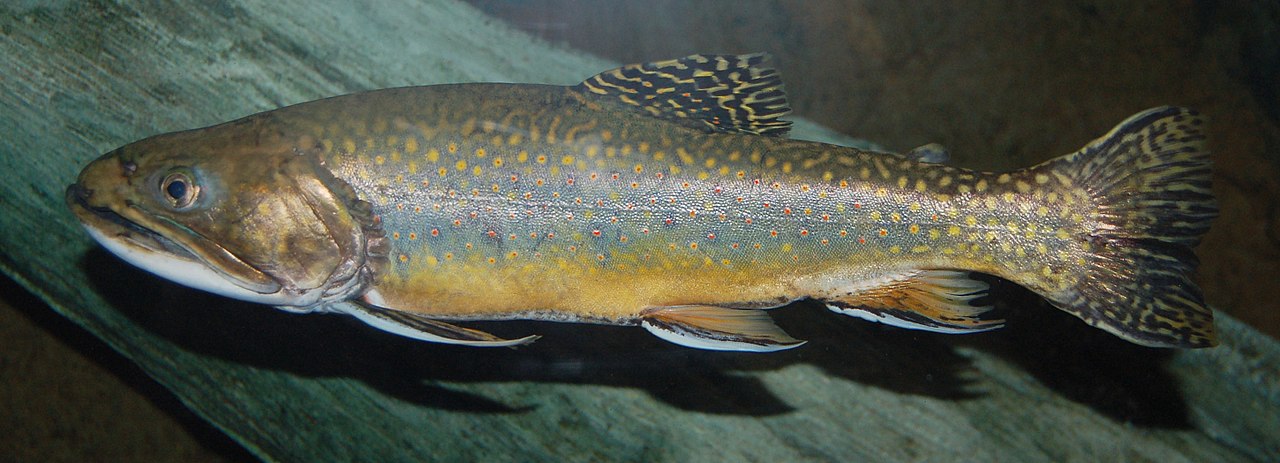

Minnesota's brook trout are native and the state holds them in two countries that share nothing but the fish. The karst spring creeks of the south-east Driftless run out of limestone; the North Shore and Arrowhead streams run off the Superior highlands as a staircase of tannic water. Both sit in the 53 to 61°F band the fish needs, and both are finished above 68. Six to eleven inches is the ordinary size in either. Lake Superior's coasters are the same species run to the lake.
What Minnesota publishes about its trout water is not a survey at all — it is a statute. Chapter 6264 designates trout streams and the tributaries that feed them, and it names no species anywhere. So the twenty waters listed on this page are designated water in the drainage size a brook trout occupies, not a record that one has been caught in any of them, and no limit here is set by species. Spawning is October and November, on gravel at the mouths of seeps.
- 53–61°FWater, preferred
- 6–11"Typical length
- NativeIn Minnesota
- 20Waters listed here
What it is
Salmonidae — char, genus Salvelinus · Salvelinus fontinalis
- Dark olive-green back carrying pale, worm-like vermiculations — the marbled pattern no other trout in these states has, and the single field mark that settles it.
- Flanks scattered with red spots ringed in blue.
- Lower fins edged in white with a black line behind it.
- Tail square, or very nearly — the name squaretail is the old one and it is a description.
Typical length in Minnesota is 6 to 11 inches. That is a curated range for water of this kind, not an average of any survey: MDNR's abundance file counts fish per acre and per mile and records no lengths at all, and no other state on this site publishes lengths either.
Native or stocked
Native, and the state has two brook trout countries that share nothing but the fish: the karst spring creeks of the south-east Driftless, and the North Shore and Arrowhead streams running off the Superior highlands, where the water is tannic and the gradient is a staircase. Lake Superior's coasters are the same species run to the lake.
Where to find it in Minnesota
Minnesota does not publish which species each segment holds. What MN DNR publishes is not a survey and not a habitat class at all — it is a law. Minnesota Rules Chapter 6264 designates trout water and the tributaries that feed it, for watershed and timber-harvest planning as much as for fishing. So this is not a list of waters this fish has been recorded from, and it is not presented as one: it is the state's own designated water, filtered to the drainage size this species occupies and ranked with the designated stream ahead of the protected tributary. Treat it as where to start looking.
| Water | Watershed | Classified miles | Class |
|---|---|---|---|
| Clear Creek | Beartrap and Nemadji | 15.3 | Designated trout stream — Chapter 6264 |
| Plouff Creek | Baptism and Brule (North Shore) | 13.9 | Designated trout stream — Chapter 6264 |
| Little Knife River | Beaver and Lester (North Shore) | 13.0 | Designated trout stream — Chapter 6264 |
| Breda Creek | Cloquet River | 12.4 | Designated trout stream — Chapter 6264 |
| Flute Reed River | Baptism and Brule (North Shore) | 10.5 | Designated trout stream — Chapter 6264 |
| Little Net River | Beartrap and Nemadji | 10.0 | Designated trout stream — Chapter 6264 |
| Miller Creek | St. Louis River | 9.6 | Designated trout stream — Chapter 6264 |
| Inga Creek | Rainy Headwaters (Boundary Waters) | 9.4 | Designated trout stream — Chapter 6264 |
| Houghtaling Creek | Baptism and Brule (North Shore) | 9.3 | Designated trout stream — Chapter 6264 |
| State Line Creek | Beartrap and Nemadji | 9.1 | Designated trout stream — Chapter 6264 |
| Kimball Creek | Baptism and Brule (North Shore) | 9.0 | Designated trout stream — Chapter 6264 |
| Kadunce River | Baptism and Brule (North Shore) | 8.8 | Designated trout stream — Chapter 6264 |
| Rock Creek | Beartrap and Nemadji | 8.4 | Designated trout stream — Chapter 6264 |
| Little Stewart River | Beaver and Lester (North Shore) | 8.3 | Designated trout stream — Chapter 6264 |
| Folly Creek | Rainy Headwaters (Boundary Waters) | 8.2 | Designated trout stream — Chapter 6264 |
| Smith Creek | Mississippi Headwaters | 8.2 | Designated trout stream — Chapter 6264 |
| Stanley Creek | Beaver and Lester (North Shore) | 8.1 | Designated trout stream — Chapter 6264 |
| Wyman Creek | St. Louis River | 8.1 | Designated trout stream — Chapter 6264 |
| West Branch Beaver River | Beaver and Lester (North Shore) | 8.0 | Designated trout stream — Chapter 6264 |
| East Branch Amity Creek | Beaver and Lester (North Shore) | 7.9 | Designated trout stream — Chapter 6264 |
Minnesota's classified trout water, whole
The inventory the list above was drawn from, by the state's own class.
| Class | Named waters | Miles |
|---|---|---|
| Designated trout stream — Chapter 6264 | 463 | 3371 |
| Protected tributary — Chapter 6264 | 23 | 25 |
Where that is on the map
Every subwatershed this site covers in Minnesota as a faint dot, and the ones holding the waters listed above lit. A coverage map with this species on it — the map on the front of the site is the map.
When to fish for it
Brook trout hold 53–61°F water and are under real stress above 68°F. On this map's own colours that band is cold, cold-transitional water, which is what the river pages and the live map are painting when they run green and blue. The season follows the temperature rather than the calendar: the water is in the band early and late in the day through the summer, and all day either side of it.
Spawning: October and November, on gravel in groundwater-fed shallows, often at the mouths of seeps rather than in the main current.
What is hatching in Minnesota, month by month, from the same seed the app's hatch panel reasons from. These are the state's recorded hatches, not this species' — trout eat what is in the water.
| Month | Peaking |
|---|---|
| January | Little Black Stonefly, Midge |
| February | Little Black Stonefly, Midge |
| March | Blue-Winged Olive, Little Black Stonefly, Midge |
| April | Blue-Winged Olive, Hendrickson, Little Black Stonefly, Little Brown Stonefly, Little Sister Caddis, Midge |
| May | Blue-Winged Olive, Giant Black Stonefly (Salmonfly), Grannom, Little Black Caddis, Little Brown Stonefly, Little Sister Caddis and 3 more |
| June | Blue Quill, Brown Drake, Cranefly, Golden Stonefly, Grannom, Light Cahill and 8 more |
| July | Cranefly, Cricket, Golden Drake, Golden Stonefly, Grasshopper, Little Sister Caddis and 5 more |
| August | Cricket, Grasshopper, Midge, Trico, White Miller |
| September | Blue-Winged Olive, Cricket, Grasshopper, Midge, Trico |
| October | Blue-Winged Olive, Midge |
How to catch it
The coldest and smallest water available: spring-fed headwaters, groundwater seeps, beaver flowages and the shaded upper reaches above where brown trout take over.
Patterns from this site's book, chosen by the insects recorded from Minnesota's own regions and filtered to the kinds worth putting in front of this fish. Each one has its tying recipe.
- Pheasant Tail Nymph nymph · #12–22 — Blue Quill, Blue-Winged Olive, Hendrickson
- Elk Hair Caddis dry fly · #12–20 — Grannom, Little Black Caddis, Little Black Stonefly
- Hare's Ear Nymph nymph · #10–18 — Golden Drake, Grannom, Hendrickson
- Parachute Adams dry fly · #12–20 — Blue Quill, Brown Drake, Blue-Winged Olive
- CDC Caddis dry fly · #14–20 — Grannom, Little Black Caddis, Little Sister Caddis
- LaFontaine Sparkle Pupa emerger · #12–18 — Grannom, Little Sister Caddis, Spotted / Tan Caddis
- RS2 emerger · #16–24 — Blue Quill, Blue-Winged Olive, Midge
- Zebra Midge nymph · #18–24 — Blue-Winged Olive, Midge, Little Black Caddis
- Black Stonefly Nymph nymph · #12–18 — Giant Black Stonefly (Salmonfly), Little Black Stonefly, Little Brown Stonefly
- Chubby Chernobyl dry fly · #8–14 — Giant Black Stonefly (Salmonfly), Golden Stonefly, Grasshopper
- Griffith's Gnat dry fly · #18–24 — Midge, Little Black Stonefly, Trico
- Partridge & Orange Soft Hackle wet fly · #12–18 — Little Black Caddis, Little Sister Caddis, Spotted / Tan Caddis
Rules for brook trout in Minnesota
Minnesota does not publish its limits split by species: the bag and the season apply to trout as a group, by the class or category the water carries. So what follows is that, and not a brook trout rule dressed up as one. Snapshot taken 2026-08-17.
| Class | Bag | Season | Waters |
|---|---|---|---|
| designated trout stream | — | — | 415 |
| designated trout stream tributary | — | — | 98 |
The full Minnesota regulation page →
Habitat notes
The coldest and smallest water available: spring-fed headwaters, groundwater seeps, beaver flowages and the shaded upper reaches above where brown trout take over.
- 53–61°F preferred
- 68°F upper limit
- cold, cold-transitional on this map's colours
The four thermal classes named there are the ones every river on this site is painted with, at breaks of 58, 64 and 70°F. A river page showing cold water is showing water inside this fish's band; that is the whole point of the colour.
The other trout in Minnesota
- Brown trout in Minnesota Salmo trutta
- Rainbow trout in Minnesota Oncorhynchus mykiss
- Lake trout in Minnesota Salvelinus namaycush
Brook trout in the other states
The same fish, on different water and under different rules. Michigan's sand-bottomed rivers, Wisconsin's driftless springs, Minnesota's North Shore, Virginia's mountain brook water and North Carolina's tailwaters and freestone gradient are five fisheries, and the limits differ with them.
Open the trout map →Every trout stream near you, coloured by today's water temperature.