 BirdTrout
Open the map
BirdTrout
Open the map
Brook trout in Michigan
Salvelinus fontinalis — native to Michigan, holding water between 53 and 61°F. Michigan's own fisheries records name 20 waters here.
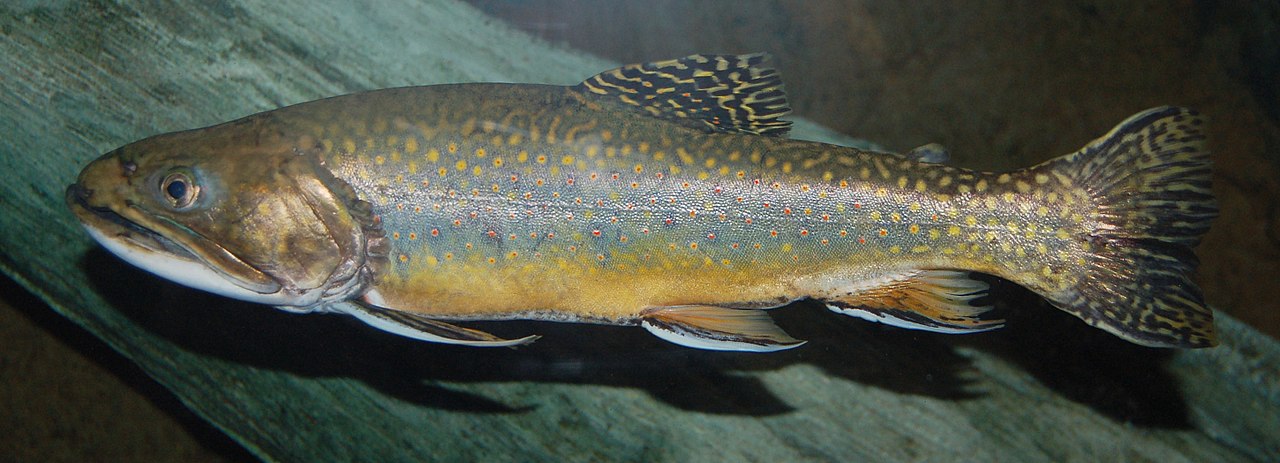

Michigan is the only state on this map where the brook trout is native and still has the whole range to itself, from the Au Sable's north branch to the sand-and-cedar creeks of the Upper Peninsula. Twenty waters with a page here carry an MDNR record of it — the Manistee and its north branch, the North Branch Au Sable, the Pine, the Boardman, Bear Creek — and twenty more are named in the survey and stocking files without a page to hang them on.
At six to eleven inches it is a small fish in most of that water, holding 53 to 61°F and out of room above 68. That band is the coldest this map paints, which is why brook trout water and the green end of a river page are the same thing. Michigan sets its minimum size per species, and brook trout carry the lowest of them.
- 53–61°FWater, preferred
- 6–11"Typical length
- NativeIn Michigan
- 20Waters listed here
What it is
Salmonidae — char, genus Salvelinus · Salvelinus fontinalis
- Dark olive-green back carrying pale, worm-like vermiculations — the marbled pattern no other trout in these states has, and the single field mark that settles it.
- Flanks scattered with red spots ringed in blue.
- Lower fins edged in white with a black line behind it.
- Tail square, or very nearly — the name squaretail is the old one and it is a description.
Typical length in Michigan is 6 to 11 inches. That is a curated range for water of this kind, not an average of any survey: MDNR's abundance file counts fish per acre and per mile and records no lengths at all, and no other state on this site publishes lengths either.
Native or stocked
Native throughout, and the fish of the Upper Peninsula and the northern Lower's spring creeks. Lake Superior's coasters are the same species run to the lake.
Where to find it in Michigan
Waters MDNR's own files put this fish in — a survey station where it was counted, or a planting site where it was stocked — matched to the river pages on this site by position, not by name. Surveyed water is listed first: a survey is a fish somebody counted, a stocking is a fish somebody put there.
| Water | Record | Latest |
|---|---|---|
| Manistee River | 6 survey stations, 85 stocking records | 2019 |
| North Branch Manistee River | 20 survey stations | 2022 |
| North Branch Au Sable River | 13 survey stations, 5 stocking records | 2019 |
| Gamble Creek | 14 survey stations | 2019 |
| Pine River | 11 survey stations | 2019 |
| Au Sable River | 4 survey stations, 9 stocking records | 2022 |
| West Branch Sturgeon River | 6 survey stations | 2019 |
| Bear Creek | 5 survey stations | 2019 |
| Boardman River | 4 survey stations | 2019 |
| Little Bear Creek | 4 survey stations | 2019 |
| South Branch Au Sable River | 3 survey stations, 1 stocking record | 2022 |
| Bigelow Creek | 3 survey stations | 2019 |
| Bear River | 20 stocking records | 2004 |
| Middle Branch Pere Marquette River | 10 stocking records | 1999 |
| Prior Creek | 6 stocking records | 1981 |
| Ogemaw Creek | 5 stocking records | 2024 |
| Swan Creek | 4 stocking records | 1989 |
| Bear Creek | 3 stocking records | 1992 |
| Big Sable River | 3 stocking records | 1998 |
| South Branch Lincoln River | 3 stocking records | 1995 |
Other Michigan waters in the same record
Named in MDNR's files without a river page here to link to — mostly lakes and Great Lakes water, which for brook trout is where the fish is. Listed rather than dropped: a page that showed nothing would read as a data failure when it is the actual shape of the fishery.
- Black River Gogebic
- Haymeadow Creek Delta
- Little Sturgeon River Cheboygan
- Warner Creek Marquette
- Cedar River Menominee
- Clear Creek Ontonagon
- Coles Creek Houghton
- Ogemaw Creek Baraga
- Taylor Creek Mackinac
- West Branch Sturgeon River Cheboygan
- Sturgeon River Baraga
- Au Sable River Crawford
- Chocolay River Marquette
- East Branch Fox River Schoolcraft
- Iron River Iron
- Middle Branch Ontonagon River Gogebic
- North Branch Manistee River Kalkaska
- North Branch Tobacco River Clare
- Pigeon River Otsego
- Rock River Alger
Where that is on the map
Every subwatershed this site covers in Michigan as a faint dot, and the ones holding the waters listed above lit. A coverage map with this species on it — the map on the front of the site is the map.
When to fish for it
Brook trout hold 53–61°F water and are under real stress above 68°F. On this map's own colours that band is cold, cold-transitional water, which is what the river pages and the live map are painting when they run green and blue. The season follows the temperature rather than the calendar: the water is in the band early and late in the day through the summer, and all day either side of it.
Spawning: October and November, on gravel in groundwater-fed shallows, often at the mouths of seeps rather than in the main current.
What is hatching in Michigan, month by month, from the same seed the app's hatch panel reasons from. These are the state's recorded hatches, not this species' — trout eat what is in the water.
| Month | Peaking |
|---|---|
| January | Aquatic Worm, Damselfly, Dragonfly, Fish Eggs, Hellgrammite, Leech and 6 more |
| February | Aquatic Worm, Damselfly, Dragonfly, Hellgrammite, Leech, Little Black Stonefly and 6 more |
| March | Aquatic Worm, Blue-Winged Olive, Damselfly, Dragonfly, Hellgrammite, Leech and 7 more |
| April | Aquatic Worm, Blackfly, Blue Quill, Blue-Winged Olive, Cranefly, Damselfly and 15 more |
| May | Alderfly, Aquatic Worm, Blackfly, Blue Quill, Blue-Winged Olive, Caterpillar and 24 more |
| June | Alderfly, Aquatic Worm, Black Ant, Blackfly, Brown Drake, Caterpillar and 32 more |
| July | Annual Cicada, Aquatic Worm, Black Ant, Caterpillar, Crayfish, Cream Cahill and 30 more |
| August | Annual Cicada, Aquatic Worm, Black Ant, Caterpillar, Cinnamon Flying Ant, Crayfish and 25 more |
| September | Aquatic Worm, Black Ant, Blue-Winged Olive, Caterpillar, Cinnamon Flying Ant, Cranefly and 22 more |
| October | Aquatic Worm, Blue-Winged Olive, Cranefly, Crayfish, Cricket, Damselfly and 13 more |
| November | Aquatic Worm, Blue-Winged Olive, Damselfly, Dragonfly, Fish Eggs, Hellgrammite and 7 more |
| December | Aquatic Worm, Damselfly, Dragonfly, Fish Eggs, Hellgrammite, Leech and 5 more |
How to catch it
The coldest and smallest water available: spring-fed headwaters, groundwater seeps, beaver flowages and the shaded upper reaches above where brown trout take over.
Patterns from this site's book, chosen by the insects recorded from Michigan's own regions and filtered to the kinds worth putting in front of this fish. Each one has its tying recipe.
- Hare's Ear Nymph nymph · #10–18 — Alderfly, Black Ant, Cream Cahill
- Pheasant Tail Nymph nymph · #12–22 — Blue Quill, Blue-Winged Olive, Damselfly
- Parachute Adams dry fly · #12–20 — Blue Quill, Brown Drake, Blue-Winged Olive
- Chubby Chernobyl dry fly · #8–14 — Annual Cicada, Giant Black Stonefly (Salmonfly), Golden Stonefly
- Elk Hair Caddis dry fly · #12–20 — Grannom, Green Sedge, Little Black Caddis
- Foam Beetle terrestrial · #12–18 — Black Ant, Cricket, Grasshopper
- Prince Nymph nymph · #10–18 — Green Sedge, Isonychia / Slate Drake, Little Black Stonefly
- Rusty Spinner dry fly · #14–20 — Cream Cahill, Isonychia / Slate Drake, Light Cahill
- RS2 emerger · #16–24 — Blue Quill, Blue-Winged Olive, Midge
- Griffith's Gnat dry fly · #18–24 — Blackfly, Midge, Cinnamon Flying Ant
- LaFontaine Sparkle Pupa emerger · #12–18 — Grannom, Green Sedge, Little Sister Caddis
- Partridge & Orange Soft Hackle wet fly · #12–18 — Alderfly, Little Black Caddis, Little Sister Caddis
Rules for brook trout in Michigan
Michigan sets a minimum size per species under each of its four stream regulation types, and these are that column for brook trout. The creel is a trout total across species, not a limit on this one. Snapshot taken 2026-08-16 — the book on the water is the book.
| Type | Minimum size | Season | Creel |
|---|---|---|---|
| Type 1 1960 waters | 7" | Last Saturday in April–September 30th | 5 fish, with no more than 3 trout 15“ or greater. Zero (0) Arctic Grayling. |
| Type 2 14 waters | 10" | Last Saturday in April–September 30th | 5 fish, with no more than 3 trout 15“ or greater. Zero (0) Arctic Grayling. |
| Type 3 59 waters | 15" | January 1st–December 31st | 5 fish, with no more than 3 trout 15“ or greater. Zero (0) Arctic Grayling. |
| Type 4 133 waters | 7" | January 1st–December 31st | 5 fish, with no more than 3 trout 15“ or greater. Zero (0) Arctic Grayling. |
The full Michigan regulation page →
Habitat notes
The coldest and smallest water available: spring-fed headwaters, groundwater seeps, beaver flowages and the shaded upper reaches above where brown trout take over.
- 53–61°F preferred
- 68°F upper limit
- cold, cold-transitional on this map's colours
The four thermal classes named there are the ones every river on this site is painted with, at breaks of 58, 64 and 70°F. A river page showing cold water is showing water inside this fish's band; that is the whole point of the colour.
The other trout in Michigan
- Brown trout in Michigan Salmo trutta
- Rainbow trout in Michigan Oncorhynchus mykiss
- Lake trout in Michigan Salvelinus namaycush
Brook trout in the other states
The same fish, on different water and under different rules. Michigan's sand-bottomed rivers, Wisconsin's driftless springs, Minnesota's North Shore, Virginia's mountain brook water and North Carolina's tailwaters and freestone gradient are five fisheries, and the limits differ with them.
Open the trout map →Every trout stream near you, coloured by today's water temperature.