 BirdTrout
Open the map
BirdTrout
Open the map
Scud (Gammarus spp.)
Crustacean, in the drift all year, active in water between 33 and 70°F, and imitated at #12–18. Recorded from 4 of the 8 regions this map covers, across Michigan, Wisconsin and Virginia.
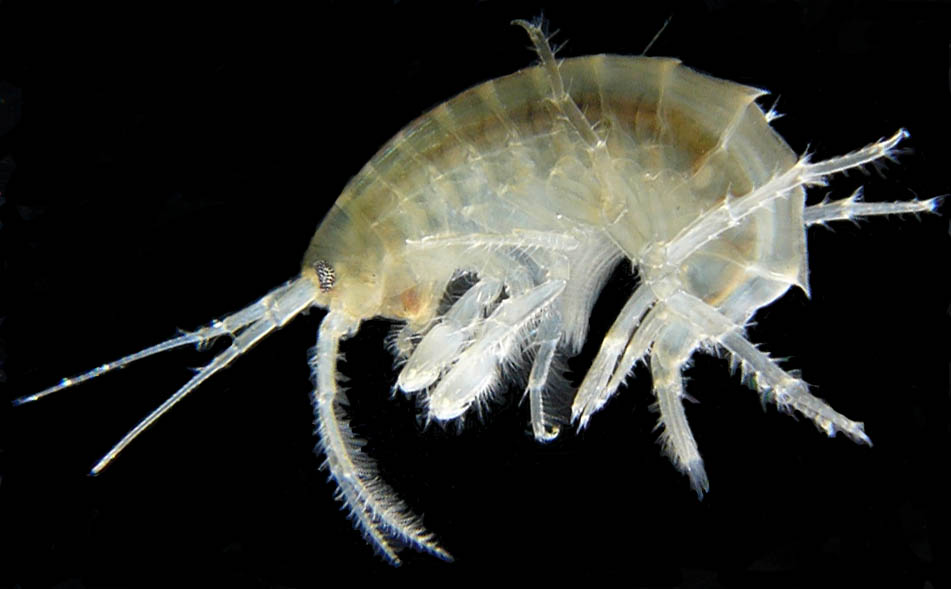

A freshwater amphipod rather than an insect: small, laterally flattened and shrimp-like, olive-grey when alive and turning orange when dead or gravid. It is abundant in spring creeks and weedy tailwaters and present every day of the year, in every month, which makes it one of the few forms with no season to wait for. Where there is watercress there are scuds. The adult swims in short darting runs among weed, and the imitation is fished dead-drift on the bottom or with the smallest twitch, never stripped. The active band is wide, 33 to 70 degrees, covering cold, cold-transitional, cool and warm water alike. Hook sizes run 12 to 18. A Grey Scud or Orange Scud in 12 to 18 matches the two colour states directly; a Hare's Ear 10 to 18, a Sowbug 14 to 18, or Walt's Worm 12 to 18 serve the same purpose.
- #12–18Hook size
- 33–70°FWater, active
- all yearAvailable
- 1Life stage fished
What it is
Crustacean · Gammarus spp. · adult
A freshwater amphipod: a small, laterally flattened, shrimp-like crustacean, olive-grey when alive and turning orange when dead or gravid. Abundant in spring creeks and weedy tailwaters, present every day of the year.
Spring creeks and tailwaters, every month of the year. Where there is watercress there are scuds.
When it hatches
In the water twelve months a year, which is why the panel in the app ranks it below anything with a season.
peak shoulder not recommended
Water conditions
The band is a water temperature, not an air temperature, and it is the range in which this insect is worth fishing — for a mayfly that is the emergence window; for a scud or a midge it is simply the range trout will still eat one in.
Active from 33°F to 70°F. On this map that is cold, cold-transitional, cool, warm water — the band crosses 3 of the three breaks the river colours use. Breaks at 58, 64 and 70°F.
Stages
What the insect is doing, and what that means for what you tie on.
| Stage | What it is |
|---|---|
| adult | Swims in short darting runs among weed. Fished dead-drift on the bottom or with the smallest twitch — never stripped. |
Matching flies
7 patterns in this book imitate the Scud, across its stages. Which one to tie on follows the stage the water temperature says it is in — the app makes that call on a live reading; this page lists the whole set.
- Hare's Ear Nymph nymph · #10–18 — Looks like everything and nothing. The other half of a two-nymph rig.
- Ray Charles nymph · #14–18 — A grey shellback sowbug with no legs and no tail. Named because it is tied blind-simple, and it outfishes elaborate sowbugs everywhere they both swim.
- Grey Scud nymph · #12–18 — The living colour. Weedy, watercress-lined spring creeks, every month.
- Olive Scud nymph · #12–18 — Live-scud olive. The colour to fish where there is weed; grey and orange are the dead and gravid ones.
- Orange Scud nymph · #12–18 — Dead scuds go orange. On spring creeks the orange one often outfishes the natural grey.
- Sowbug nymph · #14–18 — Flat, grey, unglamorous, and the main food item in limestone water.
- Walt's Worm nymph · #12–18 — Dubbing on a hook. Suggests cranefly larvae, sowbugs and everything else pale and wriggling.
Where to find it right now
The rivers with a page here that sit in this insect's regions, with a USGS gauge reporting water temperature. This list is re-ranked against the reading each gauge is sending now and today's date, so it is live — the fallback below it, if the readings do not arrive, is each river's measured July mean.
- Smith River the Virginia mountains · July mean 51.9°F
- Back Creek the Virginia mountains · July mean 49.9°F
- Big Cherry Creek the Virginia mountains · July mean 49.9°F
- Big Ivy Creek the Virginia mountains · July mean 49.9°F
- Boothe Creek the Virginia mountains · July mean 49.9°F
- Brogan Branch the Virginia mountains · July mean 49.9°F
- Browns Dan River the Virginia mountains · July mean 49.9°F
- Brushy Fork the Virginia mountains · July mean 49.9°F
- Camp Creek the Virginia mountains · July mean 49.9°F
- Conners Creek the Virginia mountains · July mean 49.9°F
Regional presence
Regions, not collection records. This insect is recorded from the coarse regions below; nobody has surveyed which named river it has been caught on, and this page will not pretend otherwise.
- the Wisconsin driftless WI
- northern lower Michigan MI
- southern lower Michigan MI
- the Virginia mountains VA
Rivers in these regions with a page here
- Au Sable River
- Jackson River
- Muskegon River
- Smith River
- Tygart Valley River
- Kalamazoo River
- Aaron Run
- Aarons Run
- Abb Run
- Abes Run
- Abram Creek
- Acme Creek
- Adams Creek
- Adamson Run
- Addis Creek
- Adkins Rockhouse Branch
- Alabaster Whitney Drain
- Aldrich Branch
- Alec Run
- Allen Creek
- Allen Creek
- Als Run
- Alum Creek
- Amos Branch
- and 2746 more
Related hatches
Same family, or overlapping this one's calendar on the same water.
- Crayfish Orconectes spp. · Crustacean · May–October
- Sowbug Asellus spp. · Crustacean · all year
- Black Ant Formicidae · Terrestrial · June–September
- Blackfly Simulium spp. · Midge · April–June
- Blue-Winged Olive Baetis spp. · Mayfly · March–May and September–November